

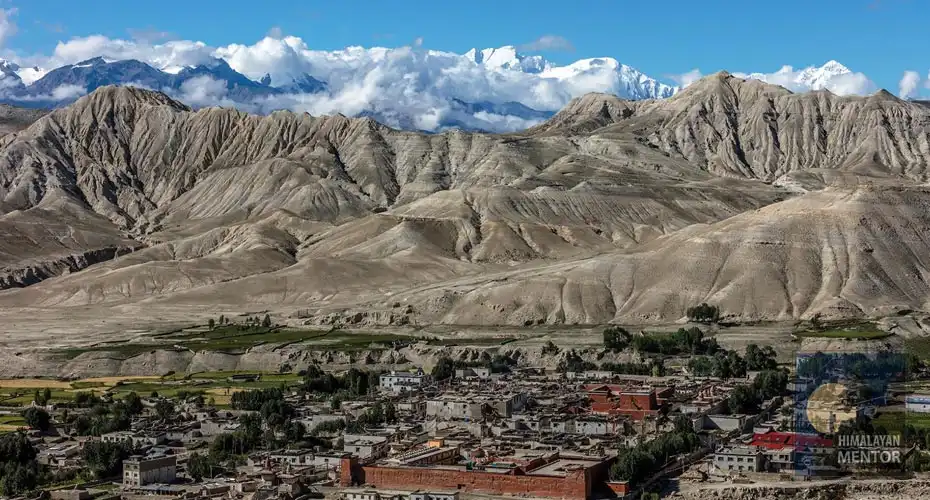
Upper Mustang Trekking Highlights
- Trek into the legendary Upper Mustang, once known as the “Lost Tibetan Kingdom”
- Explore the ancient walled city of Lo Manthang, the historic capital of the former Kingdom of Mustang
- Walk through the dramatic Trans-Himalayan landscape, with red cliffs, deep gorges and wind-carved rock formations
- Experience the dry rain-shadow region of the Himalayas, making Upper Mustang suitable for trekking during the summer monsoon season as well
- Discover the ancient villages of Tiri, Chhusang, Chele, Samar, Ghiling, Dhakmar, Yara and Tange
- Visit Chungsi Cave, a remarkable Buddhist meditation site carved into the cliffs
- Explore the fascinating Chhoser Valley, famous for its ancient caves and cliff dwellings
- Visit historic monasteries in Lo Manthang, including Thupchen Monastery, Chode Gompa and Jampa Monastery
- Take a day excursion to Luri Gumba, one of the most remarkable cave monasteries in Upper Mustang
- Experience the unique Tibetan Buddhist culture, traditional architecture and centuries-old way of life of Mustang’s mountain communities
- Enjoy spectacular views of the Annapurna, Dhaulagiri and Nilgiri mountain ranges
- Walk through colorful valleys, ancient settlements, cultivated fields and some of the most unusual geological landscapes in Nepal
- Continue to the sacred pilgrimage site of Muktinath and trek through the traditional village of Lupra to Jomsom
- Experience Upper Mustang through a private guided trek, allowing you to walk at a comfortable pace, take breaks when needed and spend more time exploring the places that interest you most
Upper Mustang trekking itinerary
Day 01: Arrival in Kathmandu airport Nepal. Up on arrival meet our office representative at airport and transfer to hotel/ after refreshing complete the official formalities/ briefing about the preparation and rest of the day free for your own leisure/overnight at hotel in BB Basis.
Day 02: Full day guided sightseeing around Kathmandu city- Historical Durbar Square area, Pasupatinath Temple, Boudhanath Stupa & Swyambhunath Stupa which will take you to visit Nepal’s most popular attractions and lunch break will be during the tour at best restaurants available/overnight at hotel in BB Basis.
Day 03: Fly from Katmandu to Pokhara, takes 30 minute by STOL flight and transfer to hotel for overnight. At hotel in Pokhara be refresh, rest or free for personal activities or visit Lake Side down town market. (Hotel in Pokhara BB Basis)
Day 04: Fly to Jomsom (2720m), trek to Kagbeni (2800m- 3-4 hr) and Overnight at Tea house Lodge (All meals Breakfast, Lunch & Dinner will be served at Tea House)
Day 05: Trek Kagbeni (2800m) to Chaile (Tsaile 3030m-5-6 hrs) and Overnight at Tea house Lodge (All meals Breakfast, Lunch & Dinner will be served at Tea House)
Day 06: Trek Chaile (Tsaile 3030m) to Syanbochen (3475m, 6-7 hrs) and Overnight at Tea house Lodge (All meals Breakfast, Lunch & Dinner will be served at Tea House)
Day 07: Trek Syanbochen (3475m) to Ghaymi (3520m, 6-7 hrs) and Overnight at Tea house Lodge (All meals Breakfast, Lunch & Dinner will be served at Tea House)
Day 08: Trek Ghaymi (3520m) to Charang (3560m, 4-5 hrs) and Overnight at Tea house Lodge (All meals Breakfast, Lunch & Dinner will be served at Tea House)
Day 09: Charang (3560m) to Lo Manthang (3730m, 4-5 hrs) and Overnight at Tea house Lodge (All meals Breakfast, Lunch & Dinner will be served at Tea House)
Day 10: Explore around Lo Manthang (3730m) and Overnight at Tea house Lodge (All meals Breakfast, Lunch & Dinner will be served at Tea House)
Day 11: Trek Lo Manthang (3730) to Drakmar (3810m) (6-7 hrs) and Overnight at Tea house Lodge (All meals Breakfast, Lunch & Dinner will be served at Tea House)
Day 12: Trek Drakmar (3810m) to Ghiling (3806m, 5-6 hrs) and Overnight at Tea house Lodge (All meals Breakfast, Lunch & Dinner will be served at Tea House)
Day 13: Trek Ghiling (3806m) to Chhuksang (3050m, 5-6 hrs) and Overnight at Tea house Lodge (All meals Breakfast, Lunch & Dinner will be served at Tea House)
Day 14: Trek Chhuksang (3050m) to Jomsom (2720m, 6-7 hrs) and Overnight at Tea house Lodge (All meals Breakfast, Lunch & Dinner will be served at Tea House)
Day 15: Fly back Jomsom to Pokhara and transfer to hotel, afternoon personal activities rest/shopping/sightseeing etc. (Hotel in Pokhara BB Basis)
Day 16: Next day from Pokhara fly to Kathmandu 30 min by STOL flight, Transfer to hotel, late noon shopping souvenirs around market and typical Nepali dinner party with culture show.
Day 17: Transfer to airport for International departure
or if you interested to have onward programs- wildlife safari tour, whitewater rafting/ kayaking, paragliding, sightseeing or visiting main tourist attraction of around please let us know we are happy to organize as you wish.
Note: We are flexible to customize the Upper Mustang trekking itinerary as per your holiday duration, interest & requirement.
Cost Includes
- Airport transfers - pick up and drop upon arrival and departure
- Full board basis on the way of trekking- Breakfast, Lunch and Dinner -3 meals per day and overnight accommodation at tea house lodge.
- Transportation- all land transfer by a private car or jeep based on group size
- Kathmandu- Pokhara - Kathmandu flight fare
- Necessary restricted area trekking permit and Annapurna Conservation Area Permit
- Supporting staffs (trekking guide and porter), as well as their necessary insurance, and accommodation meals allowance and salary
- 3- Nights accommodation in Kathmandu and 2-nights Pokhara in BB basis before and after the trek.
- Wildness First aid kit pack for the trekking
Cost Excludes
- Nepal visa fee and international flight fare
- Food (Lunch & Dinner) before and after the trip in Kathmandu and Pokhara.
- Personal expenses such as laundry, telephone calls, alcoholic beverages, bottled drinks (including cold drinks and mineral), tipping for guide and porter
- Travel insurance and emergency evacuation cost
- Additional costs- extra days stay, incase of flight cancellation due to the natural calamities, bad weather forecast and other unforeseen circumstances
- Personal trekking gear for the trek
Why Trek Upper Mustang?
The Upper Mustang Trek is unlike most Himalayan trekking routes in Nepal. Instead of dense forests and green mountain valleys, the trail leads through a high-altitude desert of eroded cliffs, deep gorges and ancient settlements. The journey combines the historic walled city of Lo Manthang, the caves of Chhoser, the remote village of Yara, the remarkable Luri Gumba and the pilgrimage site of Muktinath in one continuous adventure. For travelers interested in Himalayan landscapes, Tibetan Buddhist culture, ancient villages and remote mountain trails, Upper Mustang offers an experience that is difficult to find elsewhere in Nepal.
Useful Information - Upper Mustang Trek
Best Time to Trek
The best seasons for the Upper Mustang Trek are spring (March to May) and autumn (September to November). Upper Mustang lies in the rain shadow of the Annapurna and Dhaulagiri ranges, making it considerably drier than many other trekking regions of Nepal. The trek can also be undertaken during the monsoon months, particularly when travelers want to avoid the rain affecting other parts of Nepal.
Upper Mustang Trek Permit
Upper Mustang is a restricted trekking area, so trekkers need a special restricted-area permit in addition to the applicable conservation-area permit. The permit must be arranged through a registered trekking agency, and independent trekking is not permitted in Upper Mustang. Travelers should carry their passport and permit details throughout the trek.
Trekking Route and Duration
This itinerary combines overland travel and trekking. The journey begins with a drive from Pokhara to Kagbeni, followed by the trekking route through Tiri, Chhusang, Chele, Ghekar, Samar, Chungsi Cave, Ghiling, Dhakmar, Lo Manthang, Chhoser, Yara, Luri Gumba and Tange, before returning through Chhuksang, Muktinath, Lupra and Jomsom.
The trekking section includes several long days, with walking times generally ranging from 4 to 9 hours per day. The day from Yara to Tange is particularly long and requires good physical preparation.
Trekking Difficulty
The Upper Mustang Trek is considered a moderate to challenging high-altitude trek. You do not need technical climbing skills, but you should be comfortable walking for several hours on consecutive days. The trail includes steep ascents and descents, rocky terrain, high passes and exposed sections.
Regular walking or hiking in the weeks before the trek will help prepare you for the long days on the trail.
Altitude and Acclimatization
Altitude is an important consideration on the Upper Mustang Trek. The route gradually climbs from Kagbeni to elevations above 3,500 metres, with Lo Manthang at approximately 3,840 metres and the Luri Gumba excursion reaching around 4,000 metres.
The itinerary includes time for exploration and acclimatization, but trekkers should still walk at a comfortable pace, drink plenty of water and inform the guide immediately if they experience symptoms associated with altitude sickness.
Accommodation
Accommodation during the trek is generally in local teahouses and lodges. Facilities become increasingly basic as the route moves into the more remote parts of Upper Mustang. Rooms are usually simple, with shared bathroom facilities in many places. In a few places, luxury hotel options are also available for those who prefer a more comfortable stay, where such facilities are available. At higher and more remote settlements, hot showers and other facilities may be limited. In Kathmandu and Pokhara, accommodation is provided in comfortable tourist-standard hotels.
Food and Drinking Water
Teahouses and lodges serve a variety of meals, including traditional Nepali dishes such as dal bhat, as well as noodles, pasta, pizza, rice, potatoes, soups, Tibetan-style dishes and basic Western meals. Vegetarian options are generally available. Bottled and filtered water can found along the route. Trekkers should carry a reusable water bottle and use water purification tablets, drops or a suitable filtration system where necessary.
Weather and Temperature
Upper Mustang has a dry, desert-like climate, but temperatures can vary considerably between day and night. Days can be sunny and relatively warm, while mornings and evenings at higher elevations can be very cold. Strong winds are common, particularly in the afternoon. Good layers, a warm jacket, sun protection and windproof clothing are therefore important throughout the trek.
What to Pack for Upper Mustang Trek
Essential items for the Upper Mustang Trek include:
- Good-quality trekking boots
- Warm fleece and down jacket
- Windproof and waterproof outer layer
- Trekking trousers and comfortable walking clothes
- Warm hat, gloves and thermal layers
- Sun hat, sunglasses and high-SPF sunscreen
- Sleeping bag suitable for cold mountain conditions
- Reusable water bottles
- Water purification tablets or filtration system
- Headlamp and spare batteries
- Personal first-aid and essential medicines
- Trekking poles
- Personal toiletries
- Power bank and charging accessories
- Passport, permits and travel documents
Guide and Porter
A licensed local trekking guide is required for the Upper Mustang restricted area. Porters can also be arranged for travelers who prefer to carry only a daypack. Having a local guide is particularly valuable in Upper Mustang because of the remote terrain, changing trail conditions and the cultural importance of many villages and monasteries.
Internet and Mobile Network
Mobile connectivity and internet access are available in some larger villages but can be limited or unreliable in remote sections of the trek. Travelers should not expect continuous connectivity throughout the route. It is advisable to inform family or friends that communication may occasionally be unavailable.
Electricity and Charging
Electricity is available in many villages, although charging facilities can be limited in remote areas and may sometimes involve an additional fee. Carrying a power bank is strongly recommended.
Travel Insurance
Comprehensive travel insurance is compulsory for this trip. Your policy should cover high-altitude trekking, emergency medical treatment and helicopter evacuation, where applicable. Check the maximum altitude covered by your policy before departure.
Responsible Tourism
Upper Mustang is culturally and environmentally sensitive. Travelers are encouraged to respect local customs, dress appropriately when visiting monasteries, ask permission before photographing people, avoid disturbing religious objects and carry rubbish back when proper disposal facilities are unavailable. Supporting local teahouses, guides, porters and small businesses also helps ensure that tourism benefits the communities along the trekking route.
Money
ATMs and reliable banking facilities are limited once you leave the larger towns. It is advisable to carry enough Nepali rupees in cash to cover personal expenses, drinks, snacks, charging, tips and other purchases during the trek.
Tipping
Tipping is customary in Nepal's trekking industry and is generally given at the end of the trek. The amount is at the traveler's discretion and may depend on the length of the trek and the level of service provided by the guide, porter and support staff.